What the device is for
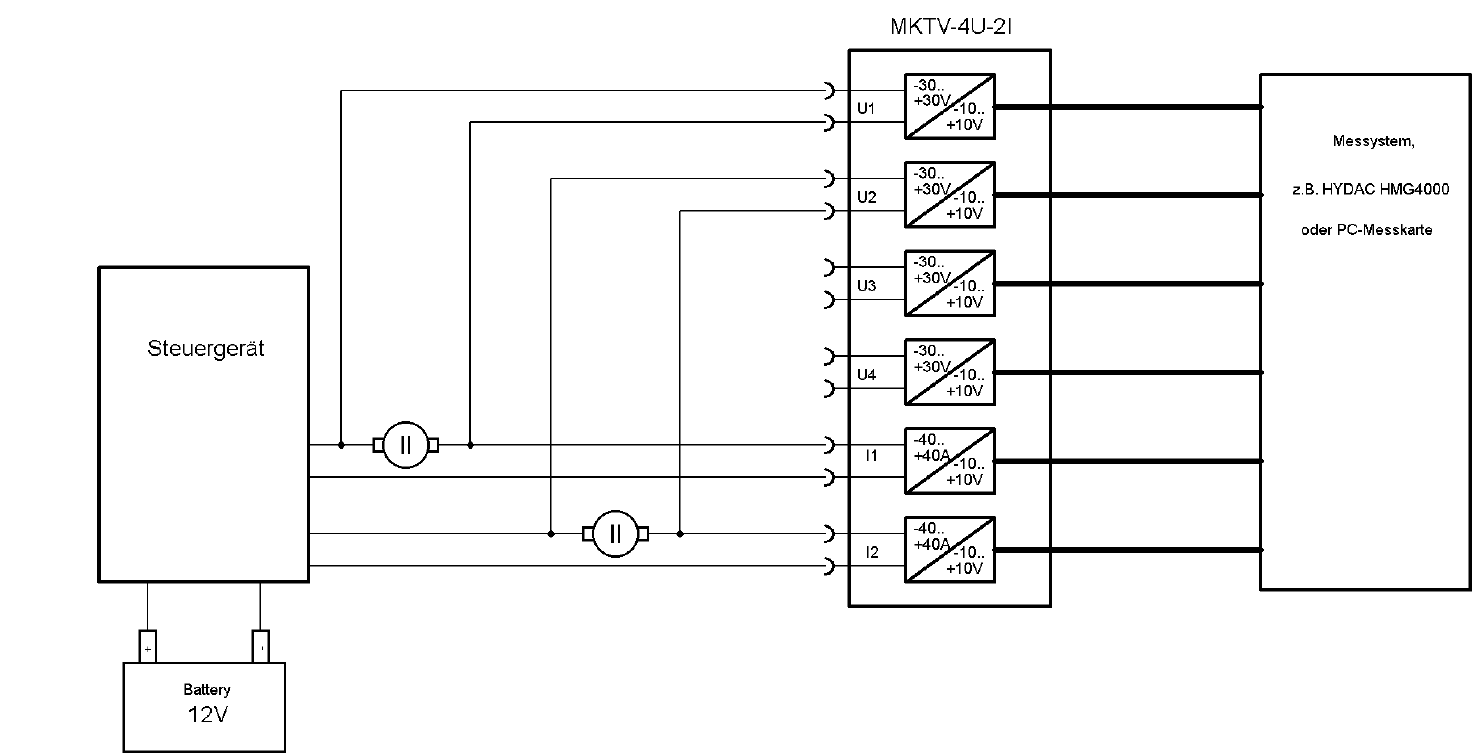
Many multi-channel measuring instruments and PC data acquisition cards share a common ground across all channels. This becomes a problem as soon as the device under test has no fixed ground potential – typically with DC motors driven by an H-bridge with PWM. Depending on the direction of rotation, either motor terminal may be connected to ground.
If one motor terminal is connected to the ground of the measuring system while another ground-referenced signal is being measured, substantial currents can flow through the measuring system and destroy it. In addition, these motors draw high currents, especially when stalled, and the voltage drop along the supply leads shifts the ground potential. Both effects corrupt the measurement or damage the equipment.
The MKTV-4U-2I galvanically isolates each channel from the measuring system and from all other channels. This allows you to
- measure voltages at any point of the device under test, regardless of its ground reference,
- measure currents on either the ground side or the supply side of the load,
- keep using your existing measuring system without exposing it to ground loop currents.
Specifications
| Parameter | Value |
|---|---|
| Voltage channels | 4 |
| Voltage input range | ±30 V |
| Voltage output signal | ±10 V for ±30 V input |
| Voltage channel error | ±0.25 % FS |
| Current channels | 2 |
| Current input range | ±40 A peak, ±25 A continuous |
| Current output signal | ±10 V for ±40 A input |
| Current channel error | ±0.5 % FS |
| Frequency range | DC to 10 kHz (voltage and current channels) |
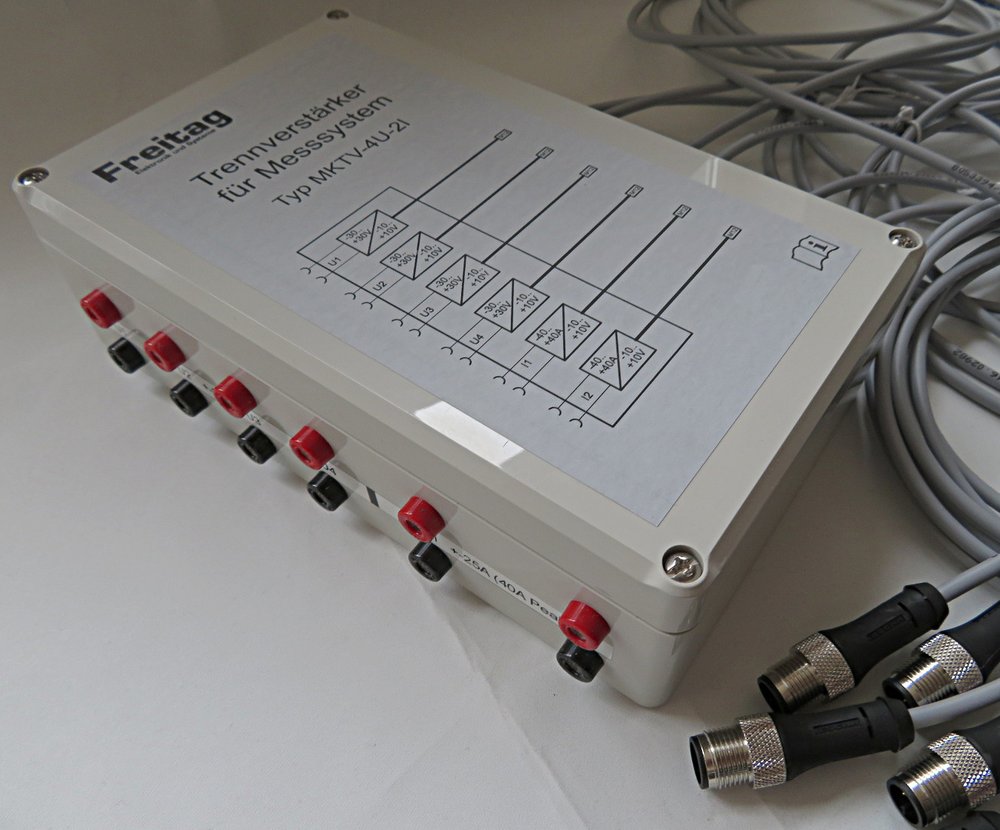
| Signal inputs | 4 mm banana sockets |
| Signal outputs | M12 connectors, pin assignment for HYDAC HMG4000, cable harness approx. 170 cm; custom connectors available |
| Power supply | 24 V DC via DC jack and included power adapter, alternatively USB-C power bank |
| Dimensions | approx. 200 × 150 × 56 mm (including sockets) |
Scope of delivery
Isolation amplifier MKTV-4U-2I, power adapter, manual.
Order number: MKTV-4U-2I
Safety notice
Setups involving vehicle electrical systems, automotive lead-acid batteries and high currents require expert knowledge. They must only be carried out in protected laboratory environments by trained personnel. Particular care and, where necessary, a barrier around the test setup are required for voltages above 42 V.